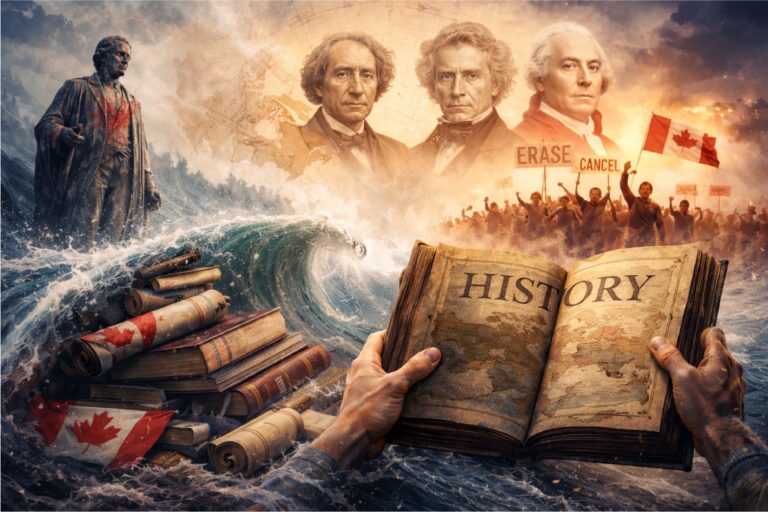
There’s a Soviet-era joke about three exiles in the Siberian gulag. One says, “I criticized Comrade Popov when he was a rising star.” The second says, “I praised Comrade Popov when his star was falling.” The third says, “I’m Sir John A. Macdonald.”
No, sorry. Actually he says, “I’m Popov.”
It has not been the tradition in Canada to erase people from history when we discover they have failings, because we realized they weren’t perfect to begin with. We left it to those who considered themselves to be without defects, like Communists, to erect statues to their superhuman predecessors, and then topple them as needed for ideological purification. In Canada, we flawed humans have put flawed heroes, and some bums, on pedestals in order to learn from history, rather than erase it.
Not any more.
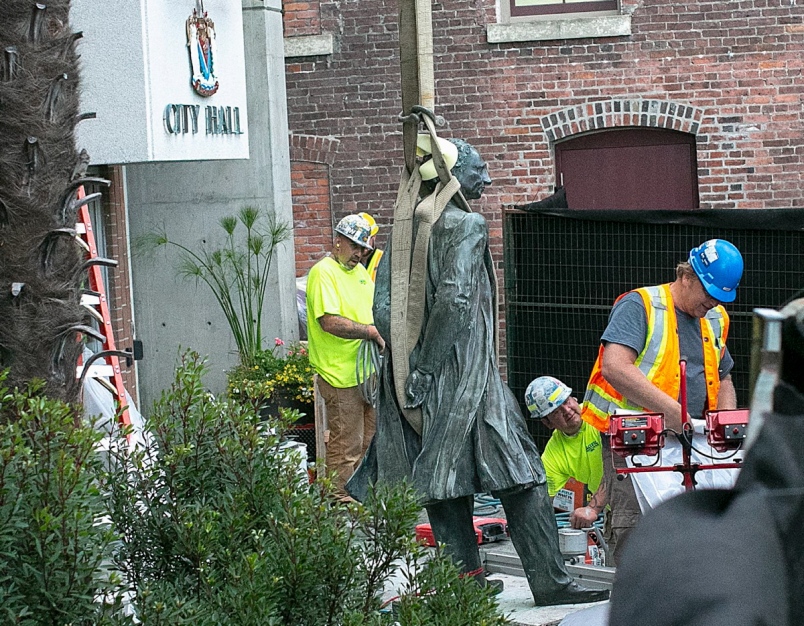
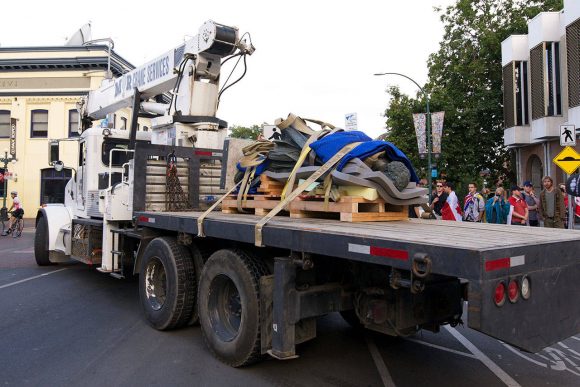
In 2009, well before Sir John A. Macdonald was carted off to a Victoria warehouse and the City of Kingston scheduled public consultations on how to “reinterpret” local memorials of the father of our country as a no-good rat, before Hector Langevin’s name was peeled off the façade of the Prime Minister’s Office in Ottawa, and before bronzed Lord Cornwallis was felled in Halifax, a planned recreation of the Battle of the Plains of Abraham was cancelled because it was too painful to admit… what? That parliamentary self-government and individual rights had triumphed over obtuse and extortionate absolutism?
No. That New France was not perfect. Five years earlier the Americans had cheerfully reenacted George Washington’s humiliating 1754 defeat at Fort Necessity. But when then-Quebec Premier Jean Charest was invited to the planned recreation of the great 1759 battle between the armies of Wolfe and Montcalm, he could not even bear the thought of it. “It’s not enough 250 years to do that,” he tsked. “Maybe at 300 years or 350, or maybe never.”
Never? That’s roughly the schedule for the Chinese politburo to face Mao’s true legacy. So instead of hundreds of weekend redcoats and bluecoats assembling on the Plains of Abraham in 2009, a bunch of poets gathered there for a celebration of the survival of the Quebecois nation. At which it evidently wasn’t too soon to read out the 1970 FLQ manifesto because, former premier Bernard Landry said, “There is nothing dishonourable in looking history straight in the eye.”
Excusez moi. But in the face of such hypocrisy I must insist that there is something dishonourable in erasing and rewriting it.
Today the impulse to purify history comes particularly from Canadians of indigenous descent, fueled by a counterfeit conviction that their own history is pristine. For all his imperfections, from excessive drinking to elasticity of principle, Sir John A. is being bundled into the memory hole on a flatbed truck essentially because of complaints by First Nations activists about residential schools, the weaponization of food against the Prairie tribes, and disparaging references to “savage” culture.
Macdonald and his contemporaries were not free from sin on these matters. But his views, and actions, have been egregiously exaggerated and misrepresented; for his time he was a model of liberal enlightenment. The key question is whether those now casting stones, or uncasting statues, are really without sin. Otherwise there’s no telling who will one day follow Macdonald into socially engineered oblivion… including their ancestors.
Modern aboriginal lobbyists certainly cherish the skills of modernity, from literacy to advanced technology, that Sir John A. was determined they must acquire so as not to have the modern world pass by, or over them. And the sanitized version of an aboriginal Garden of Eden free of war, ethnic cleansing, slavery, or cannibalism before the white serpents invaded is a fraud.
To say so is not to excuse aggression, lies or false dealing. It is to say when we erect statues in this country they are to men and women, not gods. Not for us the deification of false idols like Stalin or Mao who will lead us all to a future where, Trotsky once claimed, “Man will become immeasurably stronger, wiser, and subtler; his body will become more harmonious, his movements more rhythmic, his voice more musical…. The average human type will rise to the heights of an Aristotle, a Goethe, or a Marx. And above this ridge new peaks will rise.”
I will not dwell on the pathos of this same kind of utopian nonsense resulting in smelting Macdonald while burnishing monuments to the racist eugenicist Emily Murphy. Instead I will follow Trotsky with John Ralston Saul who nearly two decades ago said, “for better and for worse, we do not erase. Only ideological dictatorships erase.”
A major part of the glory of the West, and its strength, is self-criticism. In ancient Egypt regime change was habitually accompanied by chiseling predecessors off the very pillars. In England they kept Bad King John’s tomb, and his nickname, as an eternal reminder and warning against subsequent tyrants.
In the United States, it won’t do to pretend that statues of Confederate generals are not about slavery or that Dixie is just a tune. But I would not remove the monuments to Confederate soldiers at Gettysburg who, like the Highlanders at Culloden, deserved a better cause than that for which they fought so bravely.
I would even keep a statue of Stalin somewhere, to remind us how it invariably ends for falsifiers of history who keep erecting tin gods on tyrannical foundations until the entire squalid enterprise comes tumbling down. And to remind us how this genuine genocidal killer was supported by many Western intellectuals blinded by hatred of their own culture.
In his farewell letter, the late Senator John McCain said Americans “never hide from history. We make history.” If Canadians are to stop hiding from history and start making it again, we need the confident humility that comes of knowing flawed people can be giants.
Upon removing Macdonald’s statue, Victoria Mayor Lisa Helps said, “So John A. Macdonald, in this case, was a great man. We live in one of the greatest countries in the world, without question. And he was also the architect of the Indian Residential School system. So we need to find a way to both commemorate history and reconcile with history.” Amen to that. But wrapping the Old Chieftain in a tarp and hiding him in a warehouse is not such a way. Nor is lying about it.
My National Post colleague John Ivison, vainly objecting to renaming Langevin Block, quoted poet Maya Angelou: “History, despite its wrenching pain, cannot be unlived. But, if faced with courage, it need not be lived again.”
The hardest part of facing history is accepting that just as the greatest men and women of the past had flaws, so do we. Tearing down Macdonald is an attempt to tower over him. But new peaks are not rising here. It is a revolt of political pygmies who imagine they are giants.