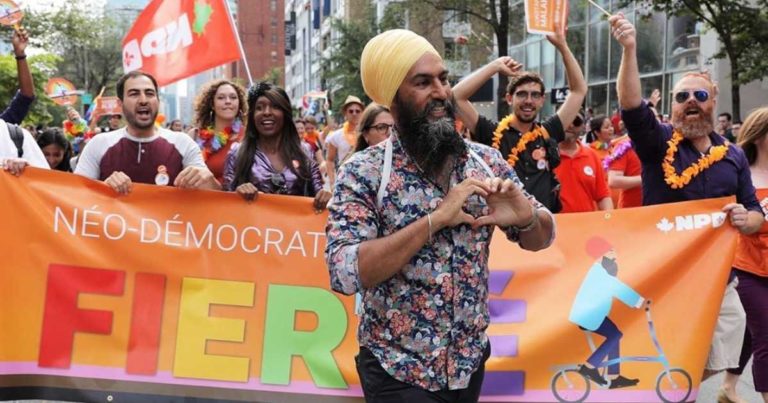
Last week Canada’s federal New Democratic Party began its multi-ballot process to elect a new leader. Among the top contenders is 38-year-old Jagmeet Singh, a handsome, charismatic, Scarborough-born lawyer noted for his progressive politics, skill in martial arts, and fashionable wardrobe. He served six years in the Ontario legislature as the NDP MPP for Brampton-Gore-Malton before resigning to enter the federal party’s leadership race last spring.
On a foggy day, and with different grooming, I could pass for Jagmeet Singh’s less brilliant kin. I doubt that the distance between the Punjabi villages of our fathers is anything close to that between Edmonton and Red Deer. I am tuned to ring with appreciation for his success. Why am I filled with apprehension instead?
Jagmeet Singh was born in Canada to Indo-Canadian parents in 1979, the year my family emigrated from India. As the country we grew up in celebrates 150 years of independence from British rule, the country our parents left celebrates 70. The political traditions of Canada and India grew out from a shared English root. Since independence both countries have been reliably more democratic than despotic (unlike many former colonial possessions of the West). Both have embraced liberal economics that have yielded impressive results – Canada has a $2 trillion GDP despite its relatively small population, and India currently ranks as the world’s seventh largest economy with a growth rate that consistently exceeds that of China. By their common colonial experience, parliamentary traditions and liberal temperament, Canada and India are natural allies.
Yet one of Jagmeet Singh’s most notable accomplishments as a lawmaker was to initiate a motion in the Ontario legislature last year declaring India a state that committed a genocide. The motion refers to three days in 1984: after two Sikh bodyguards assassinated Indian PM Indira Gandhi the country witnessed a spasm of mob violence not seen since the partition of India – about 3,000 Sikhs lost their lives. The violence was criminal and shameful, and shame accrues especially to the handful of governing party politicians who helped stir up the mob. But 3,000 dead over three days of mob violence – clearly it’s a stretch to call it a genocide.
Gandhi’s killing was inspired by a violent Sikh separatist movement in Punjab that claimed 12,000 lives, mostly moderate Sikhs and non-Sikhs, over a 15-year period before dissipating in 1997. We may compare it to the 10,000 deaths linked to the 30-year separatist turmoil in Northern Ireland. No one in their right mind would call that a genocide committed by the government of the United Kingdom. And clearly it would be unhelpful diplomacy for a government in Canada to declare it as such. What made Jagmeet Singh, at the time a provincial politician with no scope over international matters, undertake his extraordinary motion?
Far more than most Canadians realize, our country was deeply linked to that bitter period in India. The violent fundamentalism in Punjab that sought the formation of an independent state called Khalistan was largely an export from radical Sikh populations in the UK and Canada.
Separatist violence was unknown in Punjab before the 1980s, but extremist myths of a genocidal India were (and still are) nurtured in the hearts of many Canadian and British-born Sikhs by religious bigots.
These myths are a gross distortion of the ethno-cultural reality of India. The reality is that the longest-serving Indian Prime Minister since Indira Gandhi was the much-loved Sikh Manmohan Singh (leader of the party alleged by Jagmeet Singh to be genocidal against Sikhs), and the separatist wave subsided in India 20 ago.
In Canada, however, it remains vital and menacing. A continuous narrative thread connects Canadian support for the original Sikh insurrection to Jagmeet Singh’s 2016 motion in the Ontario legislature. In the middle is the worst terrorist incident in Canadian history. (Of the 268 Canadians who were killed by Sikh terrorists on Air India Flight 182 in 1985, there were 86 children, one of them a little girl from Montreal who had been the best friend of another little girl who later became my wife.) An agenda that seeks the violent dismemberment of a foreign state on theocratic lines connects this story together. Which part of his provincial and progressive mandate did Jagmeet Singh satisfy when he tabled his motion in the Ontario legislature? We might reasonably have expected a progressive politician to condemn extremist violence instead.
Religion is not a decisive factor in my identity. Though my background is not Sikh, I admire Sikhism. As spiritual practice, it is humane, egalitarian, lyrical, and disciplined. I acknowledge Sikhism as a flower of the Indian spiritual traditions. I do not pretend to read the heart of Jagmeet Singh. But the regrettable truth is that many Sikh (and non-Sikh) politicians in Canada bow to the extremist lobby. They attend Khalsa day parades and march alongside Khalistani extremists. Those who call them out face criticism, threats, or worse. After former federal Liberal minister and British Columbia NDP Premier Ujjal Dosanjh (a Sikh, and among the most decent men in Canadian politics) stood up to the extremist lobby in 1985, he was attacked in the street and viciously beaten by a man wielding an iron pipe. If we compare the stand taken by Dosanjh to that taken by Jagmeet Singh, we might wonder about the allegiances, and courage, of the latter.
Earlier this month Jagmeet Singh was rudely assailed during a campaign event by a woman shouting that he is a supporter of the Muslim Brotherhood and sharia law. He responded gracefully, offering love and patience to his attacker. A video of the exchange ignited a media outpouring of admiration for his saintly response to ignorance. Lost in the coverage was the fact that she was angry about his opposition to Quebec’s proposed ban on the niqab. Martine Ouellet, madame la cheffe of the Bloc Québécois and a fellow progressive traveler, cut through the soft-focus media swoon and noted Jagmeet Singh’s willingness to put religion before the core principles of democracy – an illustration, she said, of “the rise of the religious left”.
Jagmeet Singh’s 2016 genocide motion did not pass, but a similar one initiated by the Ontario Liberal government passed this year, with his support. No doubt the vote endeared Jagmeet Singh and the Liberals to Sikh extremists with an aggressive old-country agenda. Likewise his opposition to Quebec’s proposed niqab ban probably endears him to orthodox Muslims, and their many defenders among progressives. But as New Democrats ponder who to vote for as their next leader, they should ask themselves whether this man who aspires to be Canada’s prime minister would uphold Canadian principles of tolerance and pluralism, or pander to fundamentalists and extremists nursing ancient grudges at home and abroad.