There’s a new witch hunt against artists – and progressives are wielding the torches and pitchforks.
In May, Lou Reed’s 1972 hit “Walk on the Wild Side” caused a stir at Guelph University. In an attempt to liven up bus pass distribution at a students’ union event, the song was added to a 70s-themed playlist, but some students were apparently irked by the opening lyrics:
“Holly came from Miami, FLA / Hitchhiked her way across the USA / Plucked her eyebrows on the way / Shaved her legs and then he was a she.”
Interestingly, it wasn’t social conservative moralists who took issue with the transgressive song, but progressives who deemed it “transphobic.”
“We now know the lyrics to this song are hurtful to our friends in the trans community and we’d like to unreservedly apologize for this error in judgement,” the University of Guelph Central Student Association stated on Facebook.
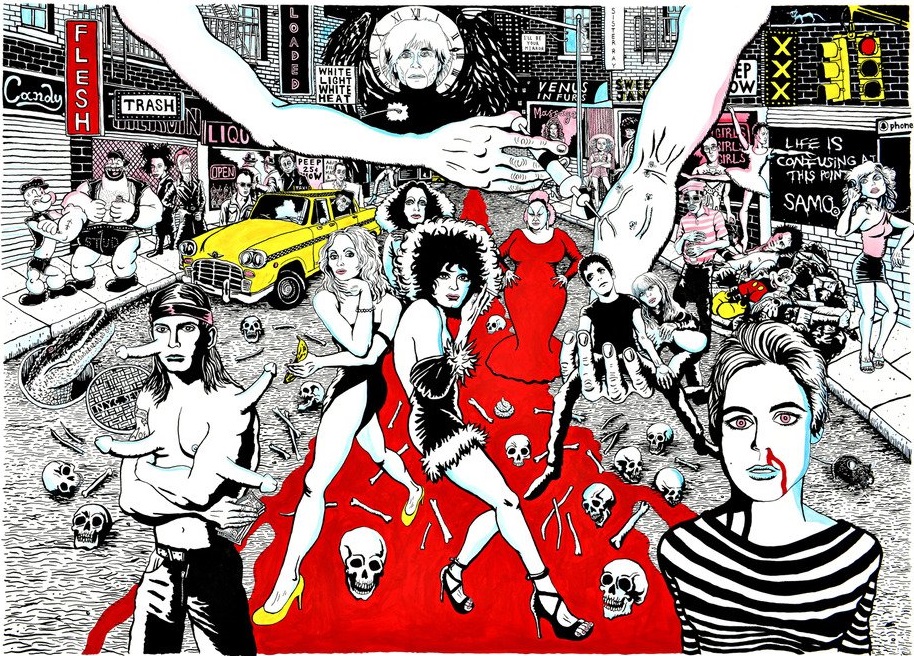
It struck many as strange that Lou Reed, of all people, would be accused of such an offence. Reed was prominent in New York’s queer community, part of Andy Warhol’s avant garde arts and music clique, and “Walk on the Wild Side” was a deliberate attempt to expose the gender-bending scene to the wider public.
The real-life subject of the song, the late actress and Warhol protégé Holly Woodlawn, told The Guardian in 2008 that the song accurately reflected her experiences as a young transgender woman, and that hearing the song on the radio for the first time marked the beginning of a lifelong friendship with Reed.
So what transformed Walk on the Wild Side from a trans anthem into a trans insult?
The answer lies in a role reversal has occurred between conservatives and progressives over freedom of expression. Forty-five years ago, conservative censors routinely tried to muzzle sexual revolutionaries like Reed. Today, after losing almost every battle, they have pretty much surrendered the field, and progressives have taken over censorship. For them, like the conservatives of old, there is no tolerance for the suggestion that one person’s art may be another’s insult. Because censorship is inherently collectivist (prioritizing a nebulously-defined “collective good” over the individual right to free expression), the principle of individual interpretation is roundly rejected.
There is at least one key difference, though, between conservative and progressive censorship. The former typically couched their objections to offensive art in religious belief or alleged social pathologies. And while both use censorship as a weapon to enforce political and ideological conformity, the latter claim the moral high ground mostly in the name of preventing hurt feelings among their favoured racial and gender minority constituencies.
This may explain a new phenomenon in the publishing world known as “sensitivity readers.” Defined by Slate’s Katy Waldman as “members of a minority group tasked specifically with examining manuscripts for hurtful, inaccurate, or inappropriate depictions of that group,” sensitivity readers are paid to call out literary microaggressions.
These “advising angels” may also crack down on problematic statements by fictional characters. Waldman’s article profiles Simon vs. the Homo Sapiens Agenda author Becky Albertalli, who came under fire for having her title character, a naïve gay teen from the south, express some questionable ideas about lesbians. Albertalli was accused of contributing to the “fetishization of queer girls.” The controversy spooked the author so much that she subjected her follow-up novel to twelve sensitivity look-overs.
In Canada, a sensitivity read might have saved the career of former Write magazine editor Hal Niedzviecki. He stepped down last month after penning an opinion piece critical of those who would ban “cultural appropriation” (writing from the perspective of someone not of an author’s race or gender) in literature. Niedzviecki sarcastically proposed an “appropriation prize” to encourage writers to include diverse characters in their works. His central argument was that fiction writers must be allowed to “explore the lives of people who aren’t like you.”
Niedzviecki apologized profusely but still lost his job. Other prominent Canadian writers and journalists rose to his defence, including Jonathan Kay, who then quit as editor of The Walrus magazine, hinting broadly that he did so because he was fed up with similar PC censorship by his employers. And after CBC news managing editor Steve Ladurantaye impulsively tweeted that he would contribute $100 to the hypothetical appropriation prize, he too offered a groveling apology – which didn’t save him from a demotion.
It seems no one is safe from progressive censorship, not even progressives.
In 2013, British pop singer and self-described feminist Lily Allen found herself under attack for her music video “Hard Out There,” a satire of sexism and cultural appropriation which was itself accused of…sexism and cultural appropriation. Initially defiant, she finally apologized in 2016, saying, “I was guilty of assuming that there was a one-size-fits-all where feminism is concerned.”
With all due respect to Ms. Allen, it seems to me that it’s the politically correct progressives who enforce a one-size-fits-all approach.
Despite its postmodern origins, progressivism is strangely dogmatic and reactionary when it comes to identity politics. If something is deemed offensive, there is no room for debate on whether the offence is reasonable (and don’t even try to argue that anyone has a right to be offensive).
Authorial intent doesn’t matter, because these censors are dealing with subconscious biases so small you need a microscope and a liberal arts degree just to view them. There is no consideration of context – what matters is the imagined effect of problematic language. Creative works must be tailored to the lowest common denominator, as audiences cannot be expected to think critically.
This is the discredited, out-of-date “hypodermic needle” theory of media effect, updated for the modern age. It’s an artless approach, one that eschews ambiguity, subtlety, provocation, and all the other hallmarks of great art.
The modern politically correct censors don’t fear social breakdown or immorality or any of the other boogeymen of old; their greatest fear is dissent. They know their ideas won’t hold up to scrutiny, which is why their arguments are cloaked in impossible-to-disprove claims and academic jargon. They would rather retreat to a safe space than take a walk on the wild side.
They’ve succeeded in stigmatizing conservatives in many spaces, and now they’re purging their own movement. This could be why they’re turning on people who should be on their side – namely, progressive artists who think too freely for their own good.
Conservatives may be tempted to laugh at these latest examples of the left cannibalizing itself – but we shouldn’t. We also suffer when artists are afraid to create, when free thinkers are afraid to express their thoughts, and when activists are afraid to defend free speech.
We’re in the midst of a new culture war, and everyone who believes in freedom of expression should be on the same side.