
On a recent Via Rail trip from Ottawa to Toronto, the train was barely half full. Good thing, because only one of the washrooms was operational. The galley ran out of sandwiches, despite how few passengers there were. The trip was otherwise pleasant, highly subsidized, and consistent with the Via passenger experience in most ways but one: the train arrived on time.
As Canada’s Auditor-General found in a special report released this week, roughly a quarter of Via trains arrive late. Not coincidentally, Via passenger volumes are falling, from 4.15 million in 2010 to 3.8 million in 2014. Revenues stagnated around $280 million during that five-year period, and amounted to less than half of operating costs in 2014. The annual federal government operating subsidy rose from $261 million to $317 million.
Even though Canada was effectively founded on a railroad, and even as the country’s urban commuter rail, LRT and subway networks continue to expand, the future of long distance passenger rail in Canada looks bleak. One might suggest privatization of Via, but who would buy a railroad that owns almost none of its own track and operates the oldest passenger rail fleet in North America? Some day it might be worth buying for carbon credits, since per passenger emissions are about 10 percent of air travel, but for the foreseeable future there is no obvious way to make long distance passenger rail competitive with airlines in a country as big as Canada. Middle distance high speed rail between high density population centres is another story, however.
Via has a plan to improve its performance by building a dedicated passenger train track in the busy Toronto-to-Montreal corridor. The company acknowledges, though, that it can’t afford to buy new railcars for the new line, and it hopes Ottawa will help out by subsidizing their manufacture by Bombardier’s rail division. However you feel about shovelling more taxpayers’ money into Canada’s premier corporate welfare sink, Via’s plan should be rejected for another, more important reason: it intends to use conventional, relatively slow train technology on the new line. That’s a mistake. The next generation of train travel in Canada should focus on developing state-of-the-art high-speed trains between major population and business centres. As experience in Japan, Europe and elsewhere has shown, this is a viable business model for modern passenger rail service, and Canada should get on board.
According to the advocacy group High Speed Rail Canada, a fast train network from Windsor to Quebec City, with stops in London, Kitchener, Toronto and Montreal, could be built for about $20 billion. Estimates for an Edmonton-Calgary bullet train have been pegged at between $3-7 billion. Costly yes, but for a much better environmental return on investment than, say, Ontario’s green energy fiasco. You could build both lines for far less than the $37 billion the province’s Auditor General says the Liberal government has blown on windmills, solar panels and sheer energy mismanagement over the last eight years, and still have plenty of money left over for a good start on high speed lines between Toronto and New York or Vancouver and Seattle.
According to Statistics Canada, 1.4 million passengers – the equivalent of 3,500 fully-loaded 747s – fly between Montreal and Toronto each year. Millions more make the trip by automobile. A two-hour train trip between these business hubs could significantly increase their economic productivity. And if a spur line were built to Ottawa, this tri-city project could pull significant traffic off the 400 series highways and maybe increase tourism to boot.
The Japanese, among others, are decades ahead of Canada on high speed rail. Here is Japanese-American journalist Bill Hosokawa in Old Man Thunder: Founder of the Bullet Train, his 1997 biography of Shinji Sogo, the Japanese inventor of Shinkansen, the first bullet train:
“During rush hours on the original 320-mile segment of the Bullet train, the equivalent of four, fully-loaded jumbo jetliners leaves Tokyo every six minutes for Osaka 320 miles away. Travelling at speeds averaging more than 120 mph, Shinkansen requires one-fifth the energy of aircraft to move an equivalent amount of passengers.”
This was the state of rail travel in Japan 20 years ago. The country’s first high speed train hit the rails in 1964, around the same time CN Rail launched its 200-kilometre-an-hour Turbo Train between Toronto and Montreal. But while Canada retreated from the challenges of developing and expanding high-speed rail, Japan went all in. Today, Shinkansen trains move millions between major population centres at speeds exceeding 300 kilometres an hour. Last year, the country set a new record with a maglev (magnetic levitation) train that topped out in a test run at 603 kilometres an hour. By 2027, maglev trains are expected to make the 286 kilometre trip from Tokyo to Nagoya in 40 minutes.
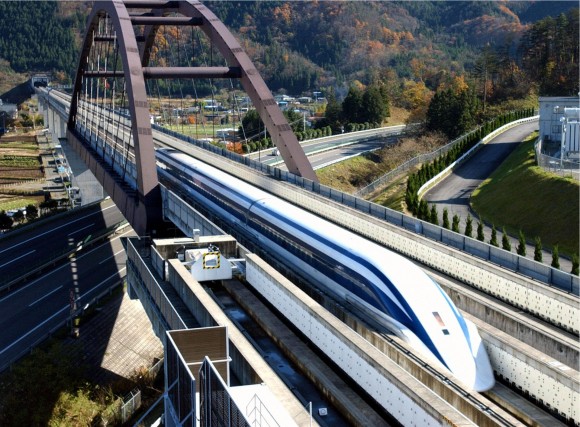
High speed passenger rail is zooming ahead in China and Europe too. Though most of it has been developed by governments, in 2012 Italy made European history with the launch of the continent’s first privately owned fast-train network. Nuovo Trasporto Viaggiatori (NTV) was the brainchild of Italian rail magnate Giuseppe Sciarrone, partnered with a former Ferrari executive and a pair of self-made millionaires in fashion and real estate. They raised a billion Euros ($1.4-billion Cdn) to buy 25 French-designed Alstom locomotives that in 2007 set the world rail speed record – 574.8 kilometres per hour – in a test run between Paris and Strasbourg.
Breaking the state monopoly on high speed passenger rail in Italy was was not easy for NTV. Several years earlier Trenitalia, a branch of state-owned Ferrovie dello Stato Italiane, had enlisted Canada’s Bombardier to help build its fast trains fleet, and succeeded in luring millions of Italians back onto trains. Sciarrone and his partners believed Trenitalia was coasting on its monopoly and there was room in the market for a private competitor. They were right: in the year following NTV’s launch total Italian fast train ridership increased by another seven million.
In an interview for this article, Sciarrone recalled the highly public battle that was fought between Trenitalia and NTV. Two weeks before the launch, Trenitalia built a fence inside Rome’s Ostiense station to prevent NTV customers from getting to the train platform from the ticket counter. Later, the state-owned railway would make sarcastic announcements to its passengers when an NTV train was running late. “When somebody tries to change something so historical, a lot of people don’t like this situation,” Sciarrone explains. “We had many enemies.”
No doubt there would be many enemies for a high speed rail builder in Canada too, starting with the CEO of Via, who told the Financial Post earlier this year that “high-speed trains wouldn’t do anything in terms of improving transportation for the vast majority of travellers between Montreal-Toronto-Ottawa”. But Yves Desjardins-Siciliano’s views should be taken with a large grain of salt, because his company has consumed a billion dollars in taxpayers’ money since 2007, and has very little to show for it.
The Trudeau government in Ottawa is famously enthused about investing big in economic infrastructure. It is no doubt contemplating both Via’s pitch for a dedicated slow-train track between Montreal and Toronto, along with Bombardier’s standing request for subsidies. Together, they probably look like a political win-win to an orthodox Laurentian Liberal.
But they’re not. Ottawa should cut the purse strings to Via and Bombardier and invite fast train builders and operators from Japan, China, Italy, France and Germany to bid on building high speed rail systems in Canada. And Prime Minister Justin Trudeau should heed the wise words of Shinkansen founder Shinji Sogo: “We must be forward-looking. Taking the position that transportation will lead the economy, not follow it.”