
The perennial strikes by college students in Québec represent one of the most misunderstood phenomena in the history of Western civilization. They are especially difficult to grasp for the rest of Canada (ROC), which doesn’t understand Québec’s distinct society. I will try to explain.
Some years ago, a separatist activist declared that we in Québec are so different from ROC that we don’t even eat the same food. Indeed, Québec is apparently one of the few places in the world where Pepsi outsells Coke. And Yukoners beat us at wine drinking, which is humiliating. We would drink only wine if we could, but it is alas too expensive.
Why, you ask, is wine so expensive in Québec? The answer is obvious: it is to protect the unionized workers of our Société des Alcools du Québec, which is also part of our distinct society. It’s a question of priority. South of the border, in Maine, they get good French Bourgogne at $5.99, a third the price Quebecers pay. But they don’t get Québec social solidarity, which is priceless.
Even Céline Dion, I am sure, dreams of leaving Los Angeles and bringing her family back to Québec. She and her husband must yearn for a real education for their children. And how do they survive without our health services? Montreal Mayor Denis Coderre recently invited Pope Francis to visit Québec in 2017. If for nothing else, he will certainly come for the health tourism.
But I digress from my main topic: the recurrent student strikes in Québec, which perfectly illustrate the fundamental difference between Québec and the rest of the world (of which ROC is a small and insignificant part). This difference is difficult to explain, especially to an Anglo audience and without violating our Québec Charter of Rights and Freedom. But let me try.
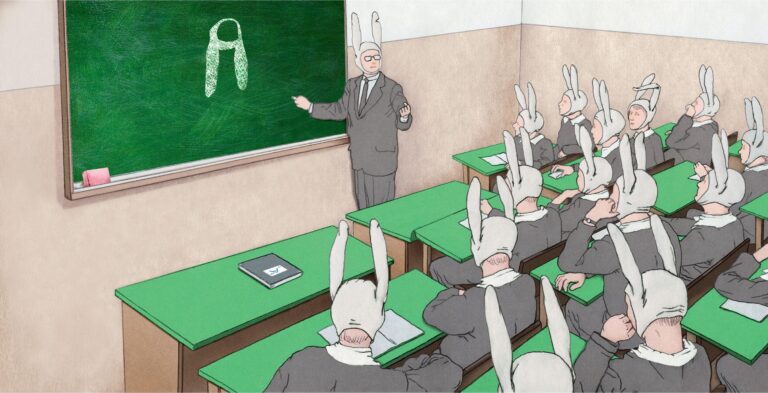
The students who forcibly interrupted classes, blocked other students from school, and vandalized college buildings, are not monsters. They are our children, and our future. We have raised these children with all the right principles: they can do what they want and society bears the responsibility. They are the first generation in the history of mankind to really see behind the lies of capitalism.
And nobody will stop them because their cause is just. Of course, they have to respect our collective will, like smoking prohibitions for example, which they do because our collective will is also their collective will. And they may not challenge our social gains, our welfare state, and our distinct society – which would never occur to them anyway.
Many teachers’ unions supported student strikes. Their members – at least those teachers who bothered to attend the union’s general assemblies – passed motions proclaiming solidarity with the strikers. Then they stayed home, at full pay, instead of going to work in empty classrooms. This was true selflessness, worthy of their students’ ideals.
College students in Québec typically pay tuition fees of about half what ROC students pay. ROC’s money helps, but not directly. Quebec’s government refuses federal money for education, because it is a provincial jurisdiction. However it does take transfer and equalization payments for things that do not offend provincial jurisdiction, thereby releasing some provincial money for education. It is of course normal for ROC taxpayers to indirectly finance Québec students: it is called solidarity, social solidarity, social and collective solidarity. But everybody cannot do solidarity, because no beneficiary would be left. If some have to do it, it’s normal that it be ROC. And somebody has to do it. QED.
As they expressed forcefully in their demonstrations, striking students are fed up with austerity, that is, of government expenditures not increasing fast enough to satisfy all their desires. It’s about time that the government either make taxpayers cough up more and/or stop giving money to other constituents. The striking students’ reasons are not selfish: they only want the money because education is good for our social and collective society.

But this analysis is not totally correct. We must not get hung up on these contemptible money matters. As socialists, we don’t like money – except as a necessary evil for the purchase of goods and services that are put to noble, collective, and social purposes. Here we start to see the true essence of the message the students are sending to us.
Look under the appearances. Why are the students striking against institutions that essentially give them something for free? I think they’re really telling the taxpayer they don’t want his money. They are striking against the gifts. They want to fend for themselves. They want to be self-reliant like their ancestors, the French Canadian pioneers, explorers, and coureurs des bois.
Even more deeply, their message may be that what they don’t want is capitalist money. They would take money happily only from the governments of Venezuela or North Korea, if they had any.
If you think that all this is logically inconsistent, you need to rethink your social conditioning under Anglo-Saxon capitalism.
Students do not engage in these strikes on a whim. They have democratic student unions, financed by compulsory levies. The students’ general assemblies are democratic – for the minority that attends them. Student leaders have a democratic mandate. Any democratic mandate from whatever group must have priority over any other democratic mandate from whatever other group. Anyone who has studied the beginning of the rudiments of Aristotelian logic in a strike-shortened semester understands that.
You have to see the big picture, the holistic whole. Québec society represents a superior model of humanity. In Québec, contrary to ROC and the United States, you don’t see people dying in the street for lack of public health insurance. You don’t see guns sold in the beer and chips department at Walmart. You don’t see students obediently swallowing what is taught to them in colleges, or even attending classes.
All this flows from the Québec education system, one of the most advanced in the world (just like the health system). So smart, so foresighted were the elites of the Quiet Revolution in the 1960s that they went a bit further than the welfare state builders in ROC: they created a brand new education system with an original set of institutions between high school and college proper. To demonstrate their creativity, they gave to these institutions a name that existed nowhere, “CEGEPs.” Many CEGEP students, still pimpled teenagers, participated in the recent college strikes. Who said that social engineering could produce no good?
When the flood of Nobel prizes soon starts engulfing Québec universities, the world will understand what I mean.
The rich culture of the typical Québec student was illustrated by a sign at one of the student demonstrations: it read “F–k toute.” This sign revealed a generous spirit of universalism by borrowing one word from the English language and misspelling the French one. The English language is truly rich. The word “toute” (everything) should of course have been written “tout,” but the demonstrator obviously wanted to stress that “everything” really means everything, including the French language. You don’t make a revolution without breaking some linguistic eggs.
It is thus clear that we have to support, not condemn, student strikes in Québec. Indeed, we have to go farther. We need a general, unlimited strike (as the adults’ unions say), instead of the short, sporadic strikes we have seen. When a college closes for a few weeks, the teachers, staff, and maintenance workers all continue to be paid, as per their collective agreements. The education the students don’t want is not provided, but it continues to cost as much.
With a general and unlimited strike, real social gains could be obtained. After a year or two of closed colleges, the collective agreements with teachers and other school staff would expire. It would then be possible to let all the employees go, so that non-education would cost no money, instead of being, as it is now, as expensive as education itself. We must therefore encourage Québec’s striking students to follow the logic of their collective demonstration of social solidarity, and to launch a general and unlimited strike.
Besides, Québec students don’t need an education anyway. They already know everything.
~
Pierre Lemieux is an economist and author who has published many books in Montréal, Paris, and New York. His latest book is Who Needs Jobs? Spreading Poverty or Increasing Welfare (New York: Palgrave Macmillan, 2014). Born in Québec, he recently moved to Maine.